
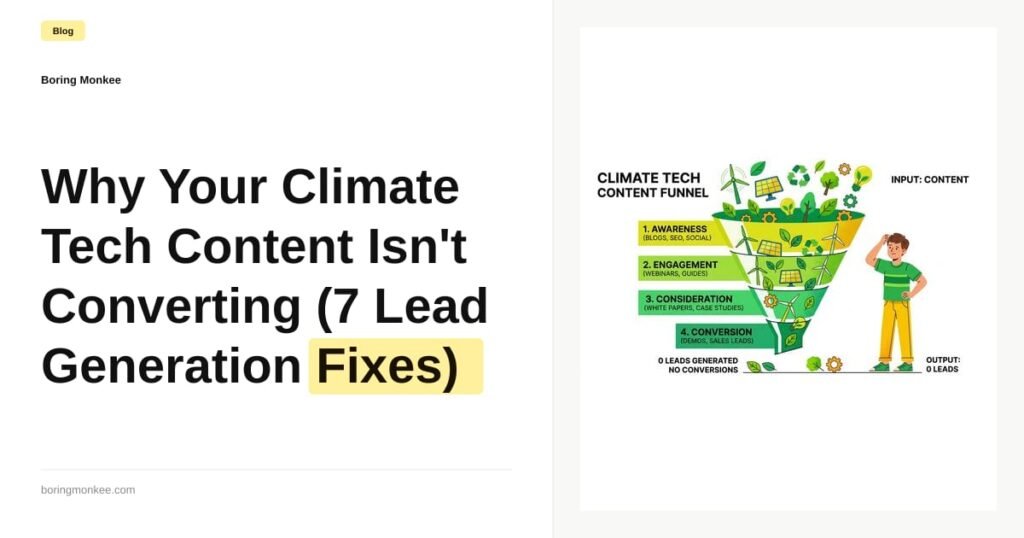
Your climate tech startup published 47 blog posts last quarter. You got 12,000 website visitors. But only 3 qualified leads came through your contact form.
The harsh truth? Most climate tech content feels like homework instead of solutions. Here are seven proven fixes to turn your content into a lead generation machine.
Why Your Content Not Generating Leads Isn’t About Traffic
Climate tech founders think more content equals more leads. Wrong.
The issue isn’t volume. It’s intent alignment. According to content strategist KP, content that doesn’t guide your audience anywhere won’t generate leads.
Your sustainability blog gets shared on LinkedIn. People comment “Great insights!” But nobody books a demo.
Here’s why: You’re solving problems your prospects don’t have. Or worse, problems they don’t know they have yet.
Climate tech buyers have three stages:
- Unaware: “We should probably think about sustainability”
- Problem-aware: “Our carbon footprint is becoming a competitive disadvantage”
- Solution-aware: “We need a carbon accounting platform that integrates with our ERP”
Most climate content targets unaware prospects. But leads come from solution-aware buyers.
Fix #1: Map Content to Buyer Intent, Not Educational Value
Stop writing “Ultimate Guide to Carbon Accounting.” Start writing “How Patagonia Reduced Scope 3 Emissions by 40% in 18 Months.”
Educational content builds awareness. Intent-driven content captures demand that already exists.
Here’s the shift:
- Instead of: “10 Benefits of Renewable Energy”
- Write: “Why Tesla’s Gigafactory Uses 100% Solar Power”
- Instead of: “What Is ESG Reporting?”
- Write: “The ESG Reporting Mistake That Cost Volkswagen $30B”
The second version attracts CFOs who are actively researching ESG compliance. That’s your buyer.
Research shows that 87% of B2B content never generates pipeline because it focuses on awareness instead of intent.
Fix #2: Add Conversion Points Every 200 Words
Your blog post is 2,000 words. You have one CTA at the bottom. That’s 1,800 words where prospects can bounce.
Climate tech buyers are busy. They scan content. If they find value in paragraph three, they should be able to convert immediately.
The 200-Word Rule
Every 200 words, add a micro-conversion:
- Download our carbon calculator
- Book a 15-minute ESG audit
- Get our sustainability ROI template
- Join our climate tech founder Slack
Don’t wait until the end. Capture intent the moment it appears.
Example: After explaining carbon accounting challenges, immediately offer: “Struggling with Scope 3 data collection? Download our supplier engagement playbook.”
Fix #3: Stop Talking Features, Start Proving Outcomes
Climate tech content is drowning in features. “Our platform has real-time monitoring, automated reporting, and AI-powered insights.”
Buyers don’t care about your dashboard. They care about their promotion.
According to Prism Global Marketing, content filled with product features instead of customer benefits fails to generate leads.
Shift to outcome-driven messaging:
- Feature: “Real-time carbon tracking”
- Outcome: “Help your sustainability team hit net-zero targets 3x faster”
- Feature: “Automated ESG reporting”
- Outcome: “Pass ESG due diligence without hiring a compliance team”
The outcome version connects to career advancement, budget approvals, and board presentations. That’s what drives action.
Fix #4: Create Content for Each Decision Maker
Climate tech purchases involve multiple stakeholders. Your content treats them all the same.
The sustainability manager cares about carbon data accuracy. The CFO cares about compliance costs. The CEO cares about competitive advantage.
Same solution. Different content.
Stakeholder-Specific Content Strategy
- For sustainability teams: Technical guides, implementation case studies
- For finance teams: ROI calculators, cost comparison tools
- For executives: Industry benchmarks, competitive analysis
Example: Don’t write “How to Choose Carbon Management Software.” Write three pieces:
- “Carbon Data Integration: Technical Requirements for Sustainability Teams”
- “Hidden Costs of ESG Non-Compliance: A CFO’s Guide”
- “Why Climate Leaders Are Outperforming the S&P 500”
Each piece attracts the same buyer journey. Different entry points.
Fix #5: Use Social Proof as Content, Not Decoration
Climate tech startups bury customer stories in case study PDFs. Make social proof your primary content format.
Instead of writing theoretical advice, document real implementations:
- “How IKEA Achieved Carbon Neutral Shipping”
- “The Renewable Energy Strategy Behind Google’s 24/7 Clean Power”
- “Why Unilever’s Sustainable Living Plan Increased Market Share”
Social proof content does three things simultaneously:
- Educates prospects on implementation
- Reduces buying risk through peer validation
- Positions your solution within successful outcomes
Thought leadership that gets climate founders funded always includes specific customer outcomes, not generic best practices.
Fix #6: Build Content Distribution Systems, Not Content Libraries
You publish one blog post per week. It gets 200 views. You wonder why content not generating leads.
The problem isn’t content quality. It’s distribution consistency.
Climate tech buyers are scattered across LinkedIn, industry forums, sustainability conferences, and regulatory newsletters. Your content needs to be everywhere they look.
The Multi-Platform Content System
One core piece becomes:
- LinkedIn article for sustainability professionals
- Twitter thread for climate tech VCs
- YouTube video for implementation teams
- Email newsletter for existing prospects
- Conference presentation for industry events
Same insights. Different formats. Maximum reach.
Content frameworks that attract high-value clients focus on distribution systems, not content creation.
Fix #7: Track Leading Indicators, Not Vanity Metrics
Climate tech content teams measure page views, social shares, and time on page. These don’t predict revenue.
LinkedIn research by Jennifer Andrews shows that companies not getting leads often lack proper tracking systems for conversion metrics.
Start measuring:
- Demo requests per content piece: Which topics drive qualification calls?
- Sales cycle acceleration: Do content-engaged leads close faster?
- Deal size correlation: Which content attracts larger opportunities?
Example: Your carbon accounting guide gets 5,000 views but zero demos. Your “ESG Due Diligence Checklist” gets 300 views but 12 qualified leads.
Double down on the checklist format. Kill the ultimate guide.
Leading indicators reveal what actually drives pipeline, not what feels educational.
Ready to Fix Your Content Strategy?
These seven fixes will transform your climate tech content from information into revenue. But implementation requires systematic execution across all platforms simultaneously.
Need help building a content distribution system that actually generates leads? Book a free strategy call to see how we’ve helped climate tech startups build brand-owned content systems that drive qualified pipeline every month.
Frequently Asked Questions
How long does it take to see leads from content marketing?
Climate tech content typically takes 3-6 months to generate consistent leads, but intent-driven content can produce results in 4-6 weeks. The key is targeting solution-aware buyers instead of building awareness from scratch. Focus on bottom-funnel content first, then expand upward.
What’s the biggest mistake climate tech companies make with content?
Writing educational content instead of decision-making content. Climate tech founders love explaining sustainability concepts, but buyers need help choosing between solutions. Create comparison guides, implementation case studies, and vendor evaluation frameworks instead of “What is carbon accounting?” posts.
How many CTAs should I include in a blog post?
Include a conversion opportunity every 200 words, plus one primary CTA at the end. Climate tech buyers scan content quickly, so capture intent the moment it appears. Use different offers throughout the post: calculators, templates, demos, or consultations.
Should I create different content for each buyer persona?
Yes, absolutely. Climate tech purchases involve sustainability teams, finance teams, and executives. Each stakeholder cares about different outcomes. Create technical guides for implementers, ROI analyses for finance, and competitive positioning for executives. Same solution, different angles.
What content formats generate the most leads for B2B climate tech?
Interactive tools like carbon calculators and ROI assessments perform best, followed by implementation case studies and comparison guides. Avoid generic “ultimate guides” and focus on specific, actionable resources that help buyers make decisions. Social proof content consistently outperforms educational content.
How do I know if my content is actually generating quality leads?
Track demo requests per content piece, sales cycle length for content-engaged leads, and average deal size by content source. Page views and social shares don’t predict revenue. Focus on conversion metrics that connect directly to pipeline and closed deals.
What’s the most effective distribution strategy for climate tech content?
Multi-platform consistency beats single-channel perfection. Repurpose every piece across LinkedIn, industry newsletters, conference presentations, and email campaigns. Climate tech buyers are scattered across different channels, so your content needs omnipresence to capture attention when buying intent emerges.