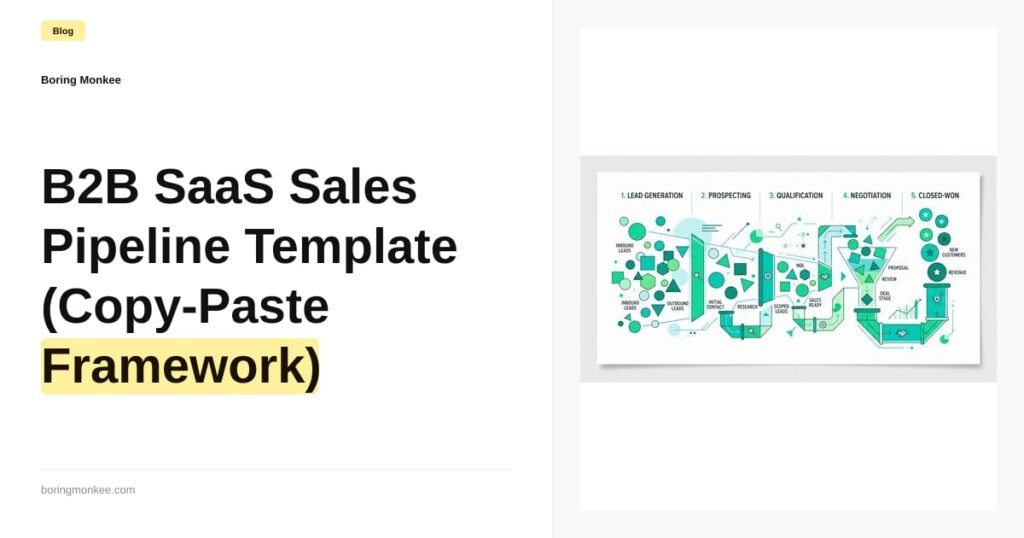
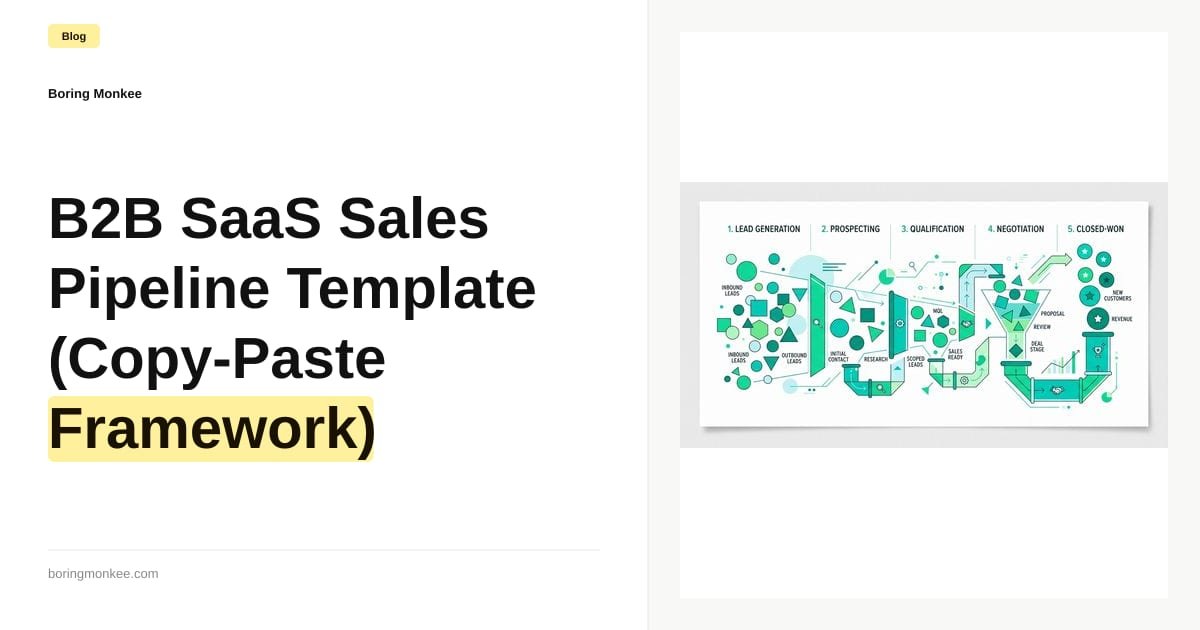
A B2B SaaS sales pipeline template is a structured framework that maps prospect movement through defined sales stages from initial contact to closed deal. The most effective templates include 6-8 standardized stages: Lead Generation, Qualification, Discovery, Proposal, Negotiation, and Closing. Each stage requires specific entry/exit criteria, conversion rate benchmarks, and sales velocity metrics. Top-performing B2B SaaS companies use templates with built-in lead scoring models, automated nurturing workflows, and CRM integration. The template should track key metrics including pipeline value, stage conversion rates, average deal size, and sales cycle length. This systematic approach increases forecast accuracy, improves sales team performance, and creates predictable revenue growth for SaaS businesses.
Most B2B SaaS companies track deals in spreadsheets and wonder why their revenue forecasts are consistently wrong.
This guide provides a copy-paste B2B SaaS sales pipeline template that turns chaotic deal tracking into predictable revenue systems.
What Should Be Included in a B2B SaaS Sales Pipeline Template?
Your B2B SaaS sales pipeline template needs clearly defined stages with specific entry and exit criteria. Without this structure, deals stall in undefined limbo.
Each stage must have measurable conversion rates and time-based benchmarks. This creates accountability and identifies bottlenecks quickly.
- Lead Generation: Marketing qualified leads entering the pipeline
- Lead Qualification: BANT criteria validation and lead scoring
- Discovery: Needs assessment and stakeholder identification
- Proposal/Demo: Product demonstration and solution presentation
- Negotiation: Contract terms and pricing discussions
- Closing: Final approval and signature collection
- Onboarding: Customer success handoff and implementation
How Do You Structure B2B SaaS Sales Stages for Maximum Conversion?
The most effective B2B SaaS sales process follows a qualification-heavy approach. Spend 60% of your time in discovery and qualification stages to avoid wasted effort on unqualified prospects.
Each stage transition requires specific deliverables and stakeholder buy-in. This prevents deals from moving prematurely through your pipeline.
Top-performing SaaS sales teams use the MEDDIC qualification framework throughout their pipeline management:
- Metrics: Quantified business impact and ROI expectations
- Economic Buyer: Budget authority and decision-making power
- Decision Criteria: Evaluation process and success metrics
- Decision Process: Timeline and approval workflow
- Identify Pain: Critical business problems your SaaS solves
- Champion: Internal advocate pushing your solution forward
| Pipeline Stage | Average Duration | Conversion Rate | Key Activities |
|---|---|---|---|
| Lead Generation | 3-5 days | 25-35% | Marketing qualified lead handoff |
| Qualification | 7-14 days | 40-50% | BANT validation, lead scoring |
| Discovery | 14-21 days | 60-70% | Needs assessment, stakeholder mapping |
| Proposal/Demo | 10-14 days | 50-60% | Product demonstration, solution design |
| Negotiation | 7-21 days | 70-80% | Contract terms, pricing discussions |
| Closing | 3-10 days | 85-95% | Final approvals, signature collection |
Your pipeline template is just the beginning — you need consistent content that keeps prospects engaged at every stage.
What Metrics Should You Track in Your B2B SaaS Sales Pipeline Template?
Pipeline metrics determine whether your sales process is healthy or broken. Track leading indicators, not just lagging revenue numbers.
The most critical metrics reveal pipeline velocity and conversion bottlenecks. Focus on metrics that help you forecast accurately and identify problems early.
- Pipeline Value: Total dollar amount of active opportunities
- Pipeline Velocity: Average time from lead to close
- Stage Conversion Rates: Percentage moving between each stage
- Average Deal Size: Revenue per closed customer
- Sales Cycle Length: Days from first contact to signature
- Win Rate: Percentage of qualified opportunities that close
- Customer Acquisition Cost: Total cost to acquire each new customer
- Lead-to-Customer Ratio: How many leads become paying customers
How Do You Implement Lead Scoring in Your Sales Pipeline Template?
Lead scoring transforms subjective qualification into objective data. Assign point values to demographic, firmographic, and behavioral indicators.
Effective lead scoring models combine fit and interest scores. This helps sales teams prioritize their outreach and follow-up efforts strategically.
Create scoring criteria based on your ideal customer profile:
- Company Size: Employee count and annual revenue brackets
- Industry Vertical: Sectors where your SaaS delivers maximum value
- Technology Stack: Existing tools that integrate with your platform
- Engagement Level: Website visits, content downloads, demo requests
- Budget Authority: Decision-making role and purchasing power
- Timeline: Urgency of implementation and go-live dates
Which CRM Systems Work Best for B2B SaaS Pipeline Management?
Your B2B SaaS sales pipeline template needs robust CRM implementation to function effectively. Choose platforms that offer native SaaS metrics and pipeline automation features.
The best CRM systems for B2B SaaS companies provide built-in sales forecasting and revenue operations capabilities. Integration with marketing automation and customer success platforms is essential.
Top CRM options for B2B SaaS pipeline management include:
- HubSpot: Free tier available, excellent for growing SaaS companies
- Salesforce: Advanced customization and enterprise-grade features
- Pipedrive: Visual pipeline management with strong automation
- Copper: Native Google Workspace integration for G Suite teams
- Close: Built specifically for inside sales and outbound prospecting
How Do You Optimize Your B2B SaaS Sales Funnel for Higher Conversion?
Sales funnel optimization requires systematic testing of each pipeline stage. Focus on reducing friction and improving qualification accuracy rather than adding more leads.
The most impactful optimizations happen in the early qualification stages. Better qualification leads to higher win rates and shorter sales cycles.
Implement these proven optimization strategies:
- Automate Lead Nurturing: Drip campaigns for prospects not ready to buy
- Improve Discovery Questions: Uncover pain points and buying criteria
- Standardize Demo Scripts: Consistent value propositions across the team
- Streamline Proposal Process: Templates that reduce time-to-quote
- Enable Self-Service: Product tours and trial experiences
- Implement Social Proof: Case studies and customer testimonials
Like founder-led content strategies, your pipeline needs consistent execution and systematic optimization to generate predictable results.
Ready to Build a High-Converting B2B SaaS Sales Pipeline?
Your sales pipeline template is the foundation, but consistent prospect engagement is what fills it with qualified opportunities. Most B2B SaaS companies struggle with pipeline generation because their content disappears between campaigns.
Book a free 20-minute strategy call to discover how our distribution systems keep your B2B SaaS brand visible to prospects every single day.
Frequently Asked Questions
How long should a B2B SaaS sales cycle be?
Average B2B SaaS sales cycles range from 30-180 days depending on deal size and complexity. Enterprise deals typically take 90-180 days while SMB sales close in 30-60 days.
What’s a good conversion rate from lead to customer?
Top B2B SaaS companies achieve 15-20% conversion rates from marketing qualified leads to customers. Lower conversion rates often indicate poor lead qualification or targeting issues.
How many pipeline stages should a B2B SaaS company have?
Most effective B2B SaaS pipelines have 6-8 stages. Too few stages lack granular tracking while too many stages create administrative overhead without meaningful insights.
Should I track pipeline value or deal count?
Track both pipeline value and deal count for complete visibility. Pipeline value shows revenue potential while deal count reveals activity levels and conversion patterns.
How often should I review pipeline performance?
Review pipeline metrics weekly for tactical adjustments