Most climate tech companies fail at marketing because they think sustainability sells itself. It doesn’t. Research shows that 73% of consumers want sustainable products, but only 5% actually buy them consistently.
Here’s what actually works: a systematic approach to sustainable marketing pillars implementation that builds trust, drives conversions, and scales with your growth.
Why Traditional Sustainable Marketing Pillars Implementation Fails
The typical three-pillar framework—people, planet, profit—sounds good in boardrooms. But it’s too abstract for real marketing execution.
Climate tech founders spend months crafting sustainability statements. They launch campaigns about saving the planet. Then they wonder why their MQLs stay flat.
The problem? You’re leading with purpose instead of proof. Your audience needs evidence before they care about your mission.
According to the Business LibreTexts research on sustainable marketing, successful implementation requires demonstrable value creation across environmental, social, and economic dimensions—not just good intentions.
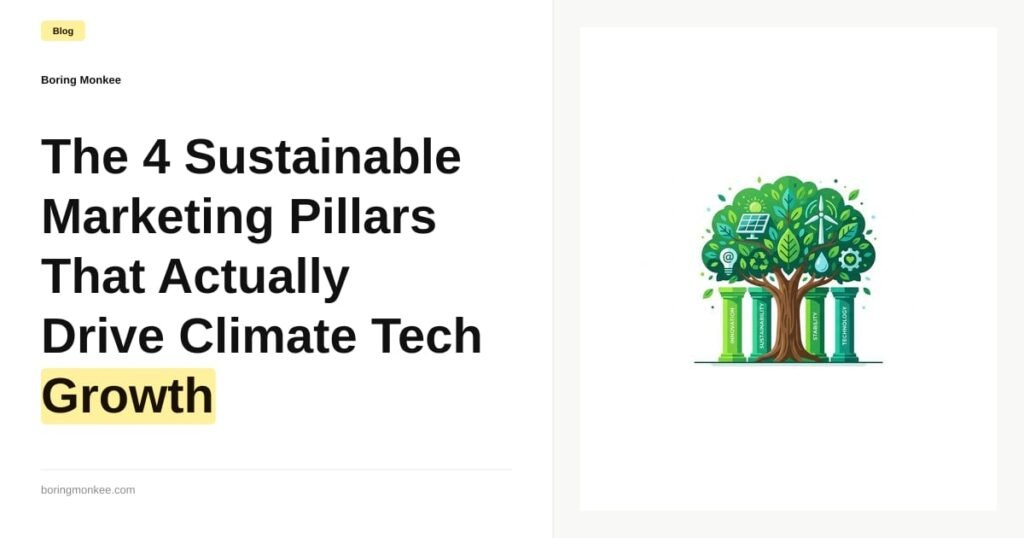
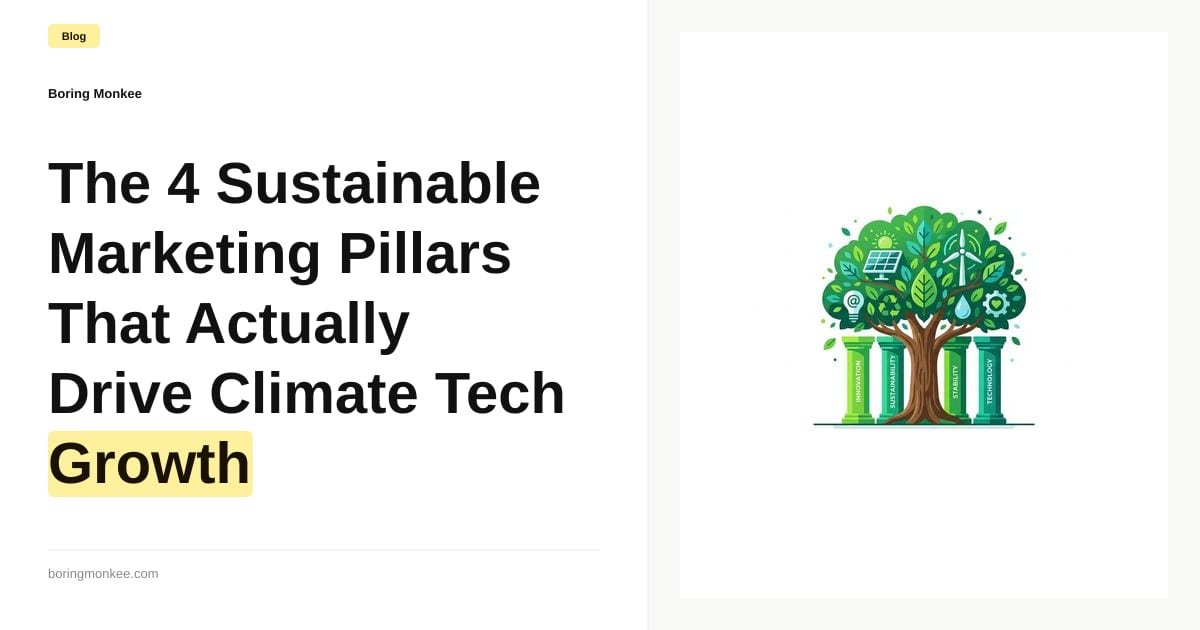
The 4 Marketing Pillars That Actually Work
Forget the textbook framework. Here are the four pillars that drive real growth for climate tech companies:
Pillar 1: Data-Driven Impact Proof
Your sustainability claims need numbers. Real ones. Not “we reduce carbon emissions” but “our technology cuts industrial CO2 output by 23% in the first 90 days.”
Tesla doesn’t just say “we’re electric.” They publish quarterly impact reports. They show exact miles driven, exact emissions avoided, exact energy saved.
This approach directly supports data-driven communication for sustainability brands that converts skeptics into customers.
Pillar 2: Audience-First Messaging
Your message isn’t about you. It’s about solving their specific problem with sustainable methods.
CFOs don’t care about saving polar bears. They care about reducing operational costs and managing ESG compliance risks. Procurement teams want supplier reliability and audit-friendly documentation.
Match your sustainability benefits to their business outcomes. Show ROI first, environmental impact second.
Pillar 3: Multi-Channel Consistency
One LinkedIn post per week won’t cut it. Your competitors are everywhere. You need to be everywhere too.
The Banzai research on sustainable marketing strategies shows that successful climate tech companies maintain consistent presence across 5-7 channels simultaneously.
This means daily content. Multiple platforms. Different voices telling the same story. Systematic social media management becomes critical for sustainable growth.
Pillar 4: Owned Distribution Systems
Don’t rent attention from ads or influencers. Build your own content distribution engine.
Create systems that generate awareness without you. AI-powered content creation combined with dedicated creator networks gives you 24/7 brand presence.
This is especially crucial for climate VCs who need consistent deal flow and portfolio companies that need sustained market visibility.
Implementation Framework: From Strategy to Execution
Theory is worthless without execution. Here’s how to implement these pillars systematically:
Week 1-2: Audit and Baseline
Map your current sustainability claims against hard data. If you can’t prove it with numbers, don’t claim it.
Document every environmental and social impact metric you can measure. Energy saved, waste reduced, jobs created, supply chain improvements.
Identify gaps where you have impact but no measurement system.
Week 3-4: Message-Market Fit
Interview 10 recent customers. Ask them why they chose you over alternatives. What business problems did you solve?
Map those problems to your sustainability features. Find the overlap between business value and environmental benefit.
Test messaging with your sales team. Do these messages help close deals faster?
Month 2: Content Distribution Setup
Build your content creation system. This isn’t about hiring one social media manager. You need multiple touchpoints.
For eco-conscious companies focused on SEO, content needs to serve both search and social simultaneously.
Consider dedicated creator placement if you’re an India-based founder doing Rs 50L+ revenue but struggling with consistent content output.
Common Implementation Mistakes (And How to Avoid Them)
Mistake 1: Leading with purpose instead of proof. Your audience needs to trust your capabilities before they care about your mission.
Mistake 2: Focusing on one channel. Eco startups need presence across multiple platforms to compete with well-funded incumbents.
Mistake 3: Inconsistent posting. Daily content beats viral content every time. Consistency builds trust. Trust drives revenue.
Mistake 4: DIY content creation. Founders burn out trying to create content while running companies. Systematic content creation requires dedicated resources.
Measuring Success: KPIs That Matter
Track these metrics to validate your sustainable marketing pillars implementation:
Business Metrics: MQLs from organic content, sales cycle length, customer acquisition cost, deal close rates.
Brand Metrics: Share of voice in sustainability discussions, brand mention sentiment, thought leadership recognition.
Content Metrics: Content consumption by target accounts, engagement from decision-makers, conversion from content to pipeline.
The Institute of Sustainability Studies research shows that successful implementation typically shows measurable improvement in these metrics within 90 days.
Industry-Specific Applications
Climate Tech: Focus on technical proof points and regulatory compliance benefits. Green branding in cleantech requires different approaches than consumer sustainability.
Sustainable Fashion: Combine transparency with style. Fashion marketing for sustainable brands needs visual storytelling and supply chain documentation.
B2B Services: Emphasize operational efficiency and risk reduction. Show how sustainability improves business metrics, not just environmental ones.
Ready to Fix Your Content Strategy?
Sustainable marketing pillar implementation requires systematic content creation and multi-channel distribution. If you’re a climate tech company or sustainability-focused business ready to build owned distribution systems that work 24/7, book a free strategy call to explore how our content distribution systems can accelerate your growth.
Frequently Asked Questions
How long does sustainable marketing pillars implementation take?
Implementation typically takes 8-12 weeks for the full framework. You’ll see initial content and messaging improvements within 3-4 weeks. Full distribution system setup and measurement baseline establishment requires 2-3 months for most climate tech companies.
What’s the difference between sustainable marketing and greenwashing?
Sustainable marketing focuses on measurable business and environmental outcomes with data-driven proof. Greenwashing makes vague claims without evidence. The key difference is specificity—real sustainable marketing provides exact metrics, timelines, and independently verifiable results.
Do I need different content for each marketing pillar?
No, but you need different messaging angles for the same core content. One case study can demonstrate data-driven impact proof for engineers, audience-first value for procurement teams, and owned distribution success for marketing leaders. Repurpose strategically across channels.
How much content creation is required for effective implementation?
Plan for daily content across 5-7 channels minimum. This means 35+ pieces per week when you account for platform-specific formatting. Most successful climate tech companies use content creator networks or dedicated placement to maintain this volume without burning out internal teams.
Can small climate tech startups compete with larger companies using these pillars?
Yes, if they focus on owned distribution and niche expertise. Large companies often struggle with consistent content creation and authentic founder-led messaging. Small teams with systematic content creation and clear positioning can outperform bigger competitors in specific market segments.
What’s the ROI of sustainable marketing pillars implementation?
Most climate tech companies see 15-25% improvement in marketing qualified leads within 90 days. Sales cycle reduction of 20-30% is common when you lead with data-driven proof instead of purpose-first messaging. Content distribution systems typically pay for themselves within 6 months through reduced customer acquisition costs.
Should I hire internally or work with an agency for implementation?
Depends on your capacity and timeline. Internal hiring takes 3-6 months and requires managing multiple specialists. Agencies or creator placement services can start immediately with proven systems. For founder-led businesses doing Rs 50L+ revenue, dedicated creator placement often provides faster ROI than building internal teams.